


Enrolled Nurses (EN) and Registered Nurses (RN) share similar scope of practice, but do you know who is best suited to care for your loved one? Read on to get a better understanding of the available types of nursing services before taking the next step in hiring a professional caregiver.
You are not alone in being confused about the difference between an EN and an RN. The healthcare field can be a maze of confusing jargon and acronyms, complicating choices of service users and professionals alike. Navigating your way around these abbreviations can help you hire the right caregiver for your loved ones.
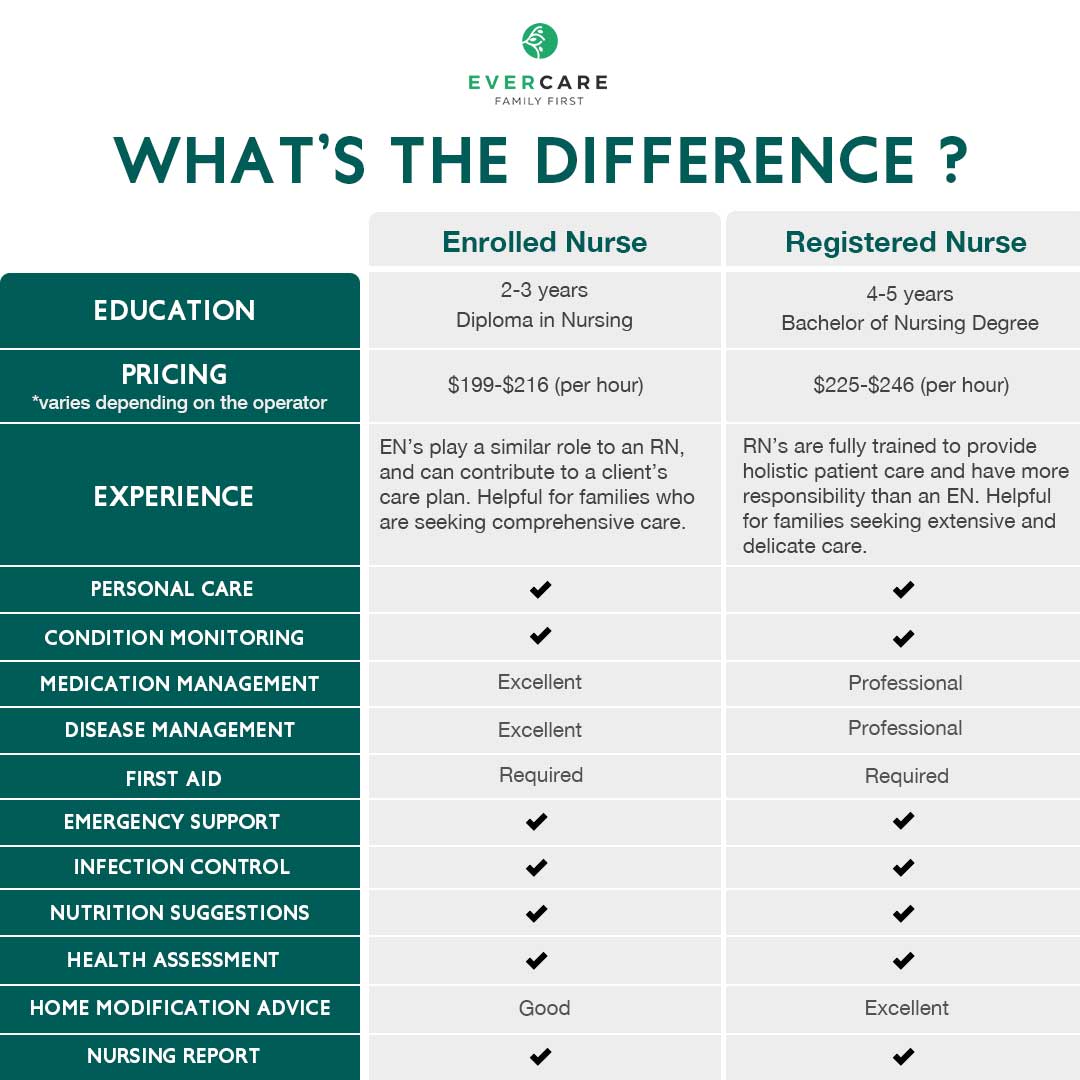
There are many different levels of nursing credentials. Both RNs and ENs are professionally certified healthcare personnel and valued members of the healthcare force. As of 2018, Hong Kong has over 56,000 registered and enrolled nurses, serving patients across every care setting. While their duties are fairly similar, the main difference lies in their qualification, education and experience.
Professional Nurse Roles:
Qualifications
- ENs: Completion of a basic general nursing program of not less than two years duration and should have registered with the Nursing Council of Hong Kong. A EN must also complete a minimum of 1600 hours of clinical practice.
- RNs: Completion of a 5-year bachelor’s nursing programme provided by local tertiary education institutions.
Duties
ENs and RNs share similar job scope. While ENs possess the basic nursing competence and professional attributes, they tend to work alongside RNs, practicing general nursing under their direction and supervision.
- Support and assist the patient with the activities of daily living (e.g., bathing, dressing), and provide for psycho-socio-spiritual needs of the patient
- Provide basic nursing care (e.g., tube insertion or removal, IV drip and vaccination, wound dressing, blood drawing, and suctioning)
*Certified dialysis nurses can also provide dialysis services
- Assess patients’ health status by observing, measuring, and recording his/her vital statistics
- Help maintain a safe environment and provide for the safety and comfort needs of the client
- Formulate care plans; participate and support ongoing quality improvement programs
- Assist in exploring resources for promoting continuity of care
Evercare has a large pool of caregivers that can provide elderly care, cancer care, stroke care and dementia care. If you are looking to find private nursing or home care services, feel free to book a consultation or contact us so that we can find the right support for you within 24 hours.
Price Comparison Between an EN and an RN
In Hong Kong, ENs are usually priced between $199-$216 (per hour), whereas a RNs is generally priced between $225-$246 (per hour). Pricing varies depending on the operator.
At Evercare, we offer competitive pricing on a wide selection of home care services. Learn more about our registered nurses and enrolled nurses hourly prices to make an informed decision that works best for you.
How to choose between the two?
Since most of the ENs graduate from a registered training organisation within the vocational education training (VET) sector, their training is more practical than theoretical. On the contrary, training for RN qualifications is designed based on a theoretical and philosophical framework. RNs are equipped with adequate theoretical knowledge and wide clinical exposure to take an all-encompassing view of the situation surrounding their patients.
If you are looking for someone who can perform a more comprehensive patient assessment, you could use the help of a RN. If your loved ones need help with their basic needs of living or professional nursing care, ENs would be an affordable alternative.
免責聲明: 本網站的所有網誌內容(包括文字、圖片及其他資料)僅供參考及教育用途,並不構成專業醫療建議、診斷或治療。如有任何關於健康狀況、醫療問題或護理安排的疑問,請務必諮詢醫生或其他合資格的醫療專業人員。Evercare 對任何人因使用或誤用本網誌的任何信息或內容,或因依賴該等內容而造成的任何損失、傷害或損害,概不承擔任何責任。
Disclaimer: All content, including text, graphics, images, and information, contained on this blog is for informational and educational purposes only. It is not intended to be a substitute for professional medical advice, diagnosis, or treatment. Always seek the advice of a doctor or a qualified healthcare professional with any questions you may have regarding a medical condition, health concerns, or care arrangements. Evercare assumes no responsibility or liability for any loss, injury, or damage resulting from the use or reliance on any information contained on this blog.
最新的文章 Latest Posts
其他話題 Other Topics
喜歡我們的文章嗎?
超過3,000位照顧者已經訂閱我們的資訊!訂閱我們的資訊,你可獲得免費護理工具、專家護理知識和同路人分享。立即訂閱,也可以隨時取消。請在此填寫你的姓名和電郵地址: