


There’s a common misconception that all health care professionals are the same, when, in fact, each of them undertakes specialised training, contributing to a difference in their capability level, job scope, and service pricing. This article will help you understand the many differences between an HCW and an RN.
As you care for your loved ones, you will most likely be supported by many different home care professionals, each responsible for providing specific types of care and services. Here’s a review of two of the most common — and confusing — types of health care professionals: Health Care Workers (HCW) and Registered Nurses (RN).
Health Care Worker:
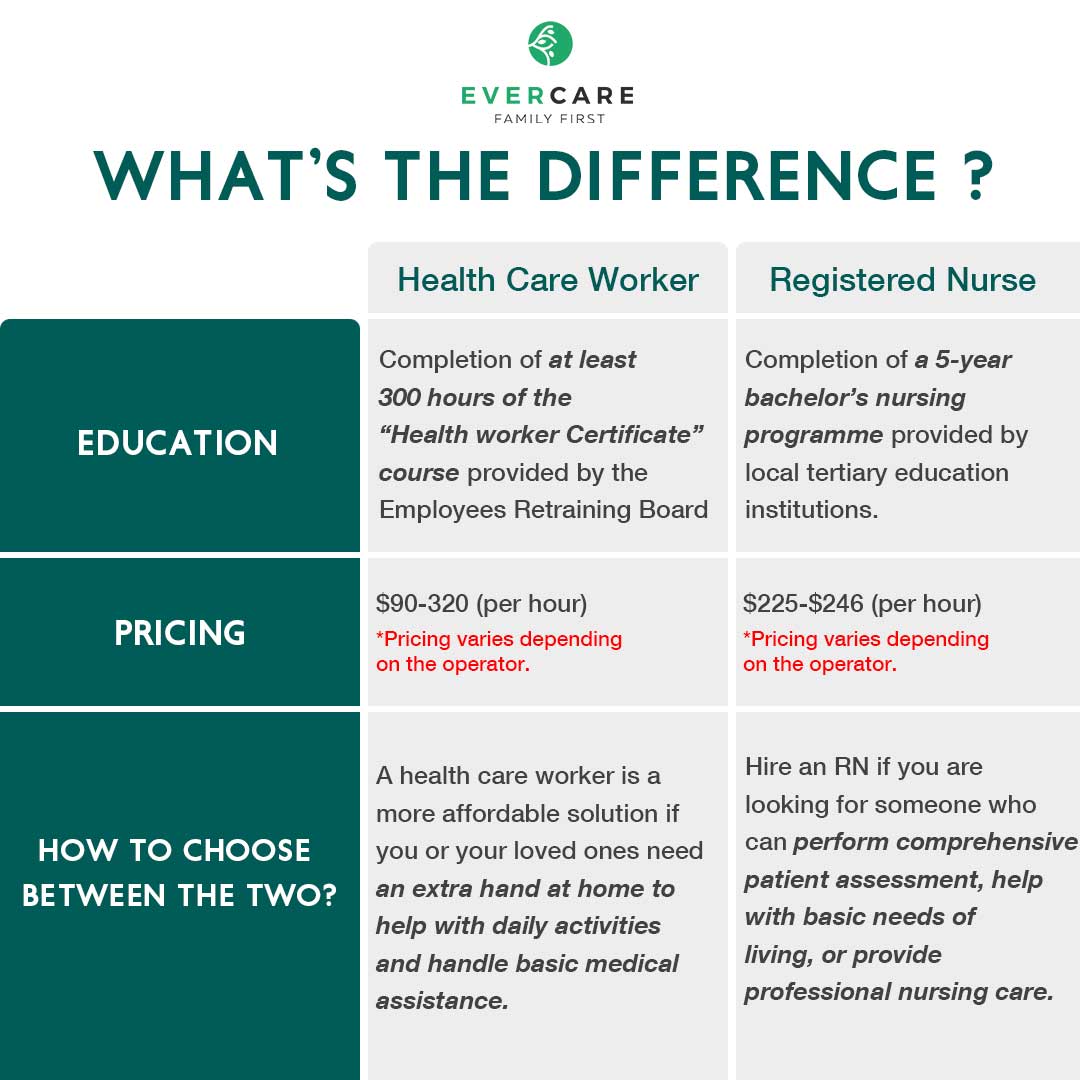
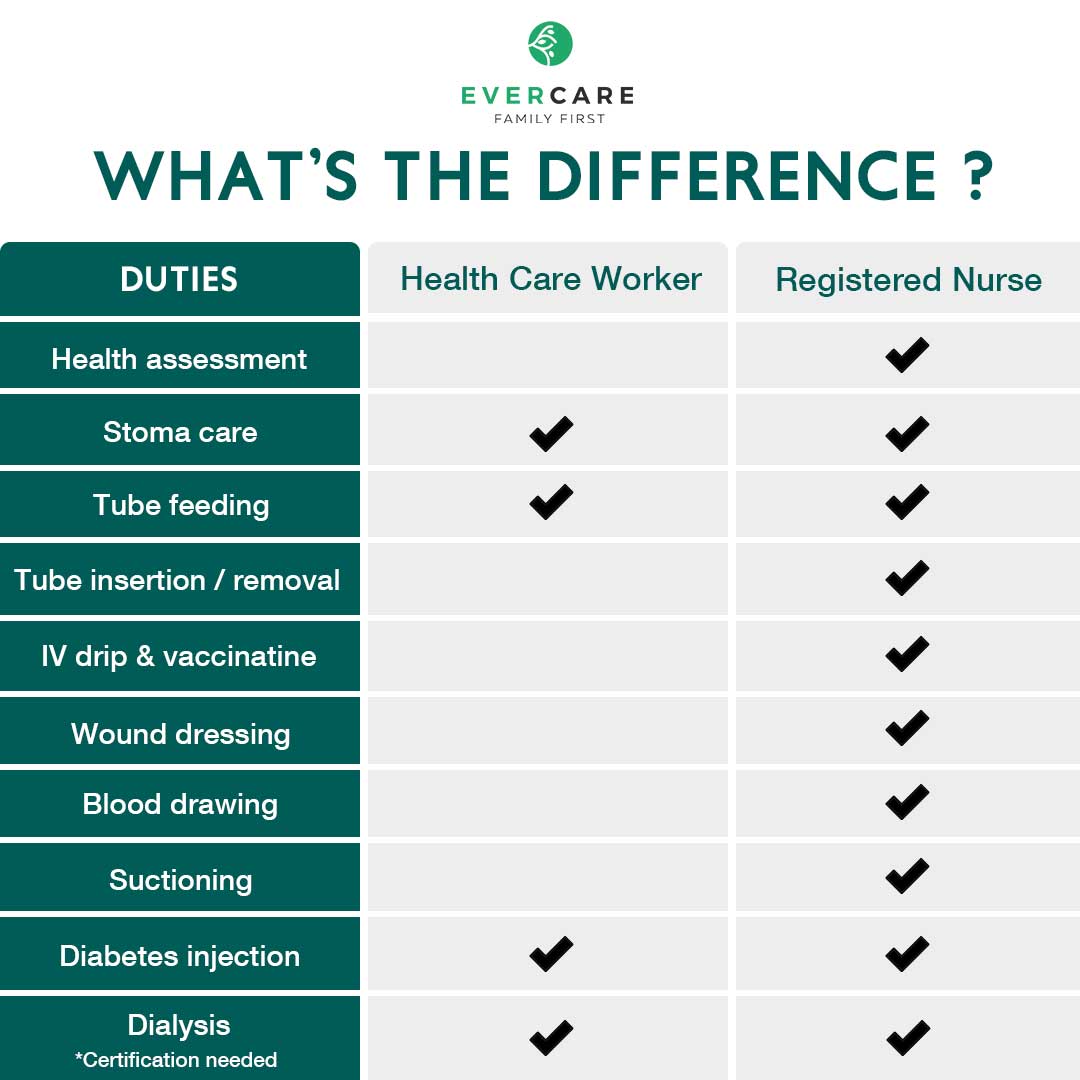
Health Care Workers assist clients with personal care tasks, including bathing and dressing. They can also provide some basic healthcare-related services, such as measuring vital signs, administering medications, or assisting with medical equipment.
In Hong Kong, health care workers must be certified. To achieve certification, a health care worker must complete at least 300 hours of formal training through the government-approved “Health Worker Certificate” course provided by the Employees Retraining Board. In order to practice, the health care worker must pass the certification examination and be registered as a health worker at the Licensing Office of Residential Care Homes for the Elderly of the Social Welfare Department .
Registered Nurse:
In a home setting, registered nurses often serve as case managers, taking care of the planning and coordination of care, overseeing all aspects of the home care service that the client receives through the agency. Registered nurses can perform health assessments, develop care plans, provide nursing care, and supervise other members of the home care team, including enrolled nurses and health care workers.
A registered nurse should hold a Bachelor’s degree in nursing obtained from a 5-year tertiary education program. To practice as a registered nurse in Hong Kong, one must be registered or enrolled as a registered nurse with the Nursing Council of Hong Kong.
Here’s a simple infographic to help you visualise the differences.
You Might Also Like:
- Enrolled Nurse (EN) and Registered Nurse (RN): What’s the Difference?
- Personal Care Workers (PCW) and Health Care Workers (HCW): what’s the difference?
免責聲明: 本網站的所有網誌內容(包括文字、圖片及其他資料)僅供參考及教育用途,並不構成專業醫療建議、診斷或治療。如有任何關於健康狀況、醫療問題或護理安排的疑問,請務必諮詢醫生或其他合資格的醫療專業人員。Evercare 對任何人因使用或誤用本網誌的任何信息或內容,或因依賴該等內容而造成的任何損失、傷害或損害,概不承擔任何責任。
Disclaimer: All content, including text, graphics, images, and information, contained on this blog is for informational and educational purposes only. It is not intended to be a substitute for professional medical advice, diagnosis, or treatment. Always seek the advice of a doctor or a qualified healthcare professional with any questions you may have regarding a medical condition, health concerns, or care arrangements. Evercare assumes no responsibility or liability for any loss, injury, or damage resulting from the use or reliance on any information contained on this blog.
最新的文章 Latest Posts


其他話題 Other Topics
喜歡我們的文章嗎?
超過3,000位照顧者已經訂閱我們的資訊!訂閱我們的資訊,你可獲得免費護理工具、專家護理知識和同路人分享。立即訂閱,也可以隨時取消。請在此填寫你的姓名和電郵地址: